
Textalyzer
https://drive.google.com/open?id=1rGDA9qojxUrcMJ7J9xbdOSMMDQa81XauDhIHD-Npf-A

The message of this advertisement can be viewed in many different ways. Dolce and Gabbana is an Italian clothing company. The thesis of the image is very male dominating, portraying very fit and similar looking men glaring and eyeing a woman lying on the ground. There are four men in the image, and one of them is pinning the woman on the ground, staring at her in a dominating way. The images theme has an overall dominating undertone.
The three men bystanding in the scene are staring down at the women pinned on the ground. This represents how the men are looking down at this woman, and how they are not only physically above her, but how they believe they are superior. The man pinning her down is controlling her. She is on the ground with her shoulders, however the rest of her body is off of the ground as her legs are propped up holding her body up.The female in the image is not giving up, and from her facial expression it is very clear that she is uncomfortable with the situation. Her head is turned away from all of the men and the scene, and her focus is away from anything in the frame.
The male pinning the woman down in the ad has sunglasses on, unlike any other man in the image, and has his attention locked on the female he is holding down. This position that he is poised in on top of her is very forceful and controlling, portraying that he is in charge. The sunglasses that he wears, however, can be interpreted in a few different ways. The sunglasses provide a barrier between eye contact of the male and female, making them even less connected. They also can be seen as making even more of a point of superiority for the man, due to the fact that he won’t even look at her with his bare eyes.
The men in the image all have differing facial expressions. The man standing the furthest away in the top left corner of the scene is adjusting his jacket and looking towards the scene, however he definitely does not have his focus on the woman on the ground or what is exactly going on in the central part of the ad. His facial expression emotes a look of uncertainty, and inattentiveness. The man to the left of him, closer to the woman is looking directly at the woman and her face. His hands are at his sides and his expression is very focussed and determined. His stance differs from the previous man, who’s hip pops out in a more relaxed pose. This man’s stance is more still and upright. However, he is a bit leaned back and his thumbs hang in his pockets, so there is a sense of relaxation there. The man all the way to the right is completely shirtless. His hands are on his hips as he stands in a much more upright and alert pose than the others. His gaze is locked in on the woman facing the opposite direction of him. Finally, the man over top of the woman is pinning her down by the wrists as he stares at the side of her face through his sunglasses. He is very clearly and directly dominating her and the situation. Although this control is clear, the other men surrounding the women are towering above her as well. Their superiority is made clear with their gaze and their stance.
All of the men stand very tall, and very fit. Two out of the four are shirtless, flexing their oiled muscles to emphasize their power and masculinity. The other male in the far left corner is wearing a button down shirt, half buttoned with their abs showing as well. The man to the left of him is wearing a button down, with much less of his skin exposed. Their clothing features their sophistication and professionalism, even in such a non traditional and unprofessional situation.
The women in the picture portrays a very different feel of the scene. Her feet and knees hold most of her body off of the ground, except for her head and shoulders that support her. Her pose shows how she is not complacent with the situation, and seems as though she would want to get up. Her face is turned towards the camera and away from any of the men, and her focus is on something out of frame. The audience is immediately drawn to her red lipstick, being the brightest and most contrasting color of the entire scene, since most of it consists of blues, whites and other lighter and more subtle colors. The red on her lips is drawing attention to the prize and can even assume what is to happen next in the scenario.
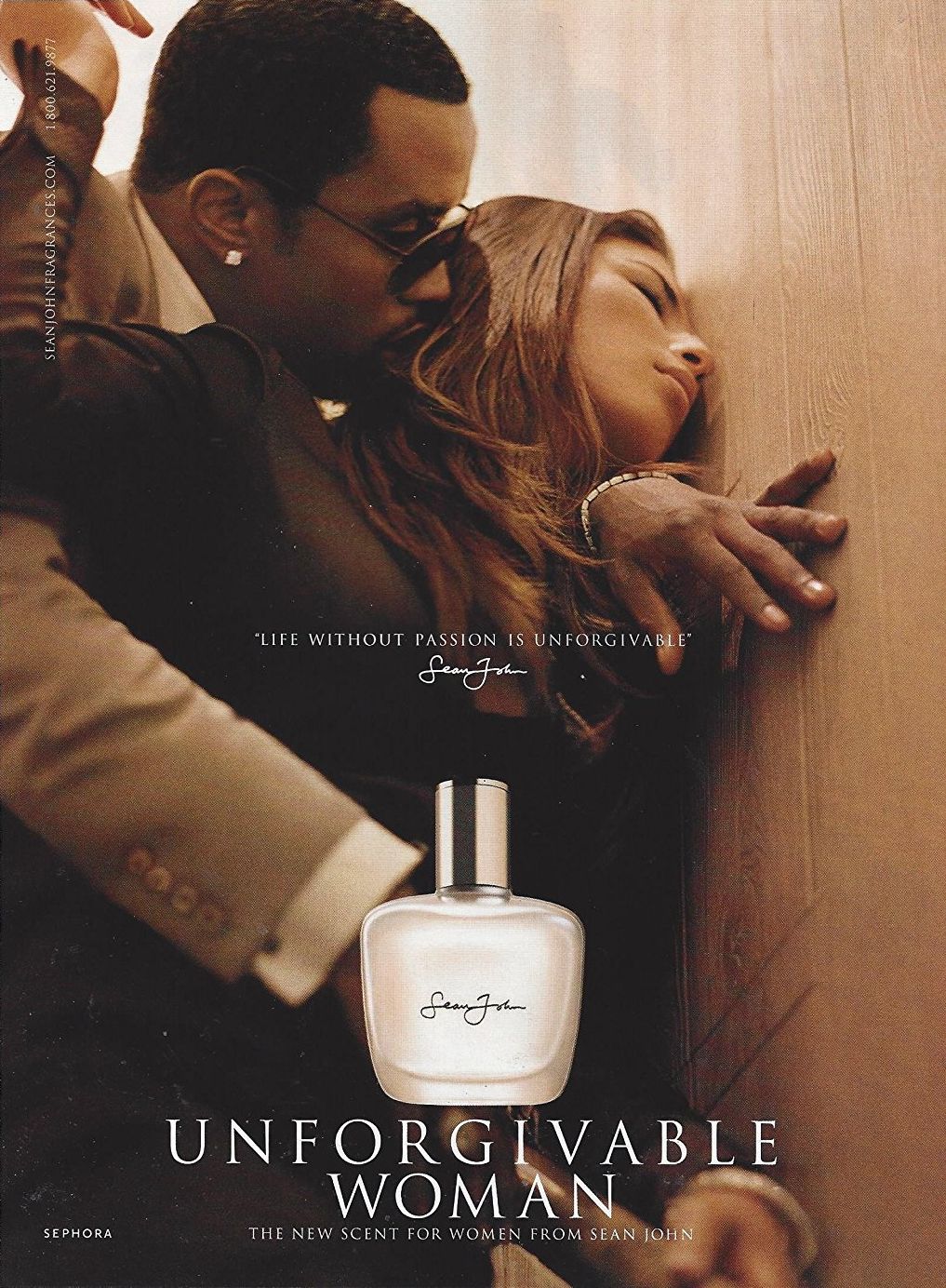
This Sephora perfume ad is particularly uncomfortable to look at. This image was obviously intended to attach a provocative and sexual desire with the appeal of perfume. however, this image very clearly shows what looks like a situation that looks forced, uncomfortable, not consensual scenario. The quote, “Life is unforgivable without passion” attempts to tie in the scent of the perfume Unforgivable Women, implying women should be unforgiving towards men or any kind of seductive scenario if it isn’t passionate. The advertisement as a whole is an eyesore to look at, at least for me personally.
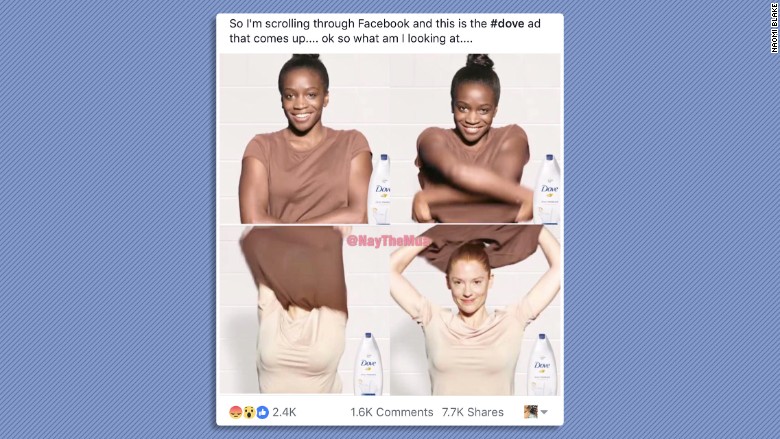
This Dove soap advertisement received a massive amount of criticism for implying racism in its 2017 debut.
“I disapprove of what you say, but I will defend to the death your right to say it.” ― S.G. Tallentyre, The Friends of Voltaire. Many stand by the right of free speech, claiming that every citizen has that right and should take full use of it. Others believe that there are certain things that should be be left unsaid. With our society’s advanced technology, and the massive popularity that surrounds social media, there is no getting around criticism of our views. What we’re saying matters; people are listening. However, everything we say seems offend someone in one way or another. The real question is, what can we really say? What is okay to talk about, and what things can we simply not say? As citizens of the United States, we have the right to voice our opinions, as untamed or unpopular as they may be. Although as individuals, we should strive to voice our thoughts in a respectable and productive manner, it is ultimately the right of civilians to articulate their thoughts in whichever way they please.
What words can we say? Many believe the use of swear words in a public manner should be censored instead of glorified. However, research actually shows that from a psychological point of view, swearing isn’t exactly a bad thing. “It is far more common to see strong offensive words used as emotionally arousing stimuli — tools to study the effect of emotion on mental processes such as attention and memory.” says Timothy Jay and Kristin Janschewitz in their article The Science of Swearing. Research continues to prove that swearing is actually promoting a deeper kind of psychological process; an emotional connection and an engaging discussion is coming out of using these words (Jay, Janschewitz). But where do we use curse words? In public? In a professional setting? The biggest wonder, and a common debate over the decades has been whether or not to swear in front of children. In Benjamin Bergen’s article titled Go Ahead, Curse in Front of Your Kids, he says go for it. “And I’m happy to report that, nowadays, if I drop an f-bomb in front of my kid, I don’t sweat it.” Bergen emphasizes that there are of course incorrect ways to use profanity in front of our children, such as verbal abuse and its psychological damages. Yet he also points out that there isn’t any scientific proof that exposing children to swear words imposes any direct harm in their lives. Bergen’s article emphasizes that there aren’t any necessarily ‘correct’ words to say in any sort of setting, and that utilizing assumed bad words can actually teach important lessons, instead of doing the presumed opposite. Although swearing in front of children is definitely not for everyone, swear words are within our language and have a proper use somewhere in our discussions and society. After mastering when and where it is appropriate and effective to utilize these words, the hope is that they will benefit our dialogue in ways that regular vocabulary has been unable to.
In the past, the main way for anyone to express their opinions was verbally. Recently, the internet is a whole advanced and unfamiliar platform, for anyone with access to publicize any kind of information they please. This kind of freedom has made constructive, healthy and useful judgement desensitized and calloused. More often than not, cruel and harmful comments are posted on the internet because they aren’t being vocalized; instead they are only read on a screen, with no face or name to attach them to. Is this what our freedom entails? To mindlessly post brutal and coldhearted comments on the internet?
As members of a free society, we constantly face criticism for nearly everything we say, especially on the internet. For instance, Bergen has assumably received criticism for the way he chooses to swear in front of his children. But, when does this criticism go too far? Laci Green faced this overwhelming critique, that many would seem as cruel and unnecessary. In Words You Can’t Say, a podcast hosted by Ira Glass, Green discussed how in her online sex ed videos she was being harassed and receiving threats from viewers for using the words male and female (Glass, 16:00). Green was simply discussing the anatomy of a penis and a vagina, and faced a massive amount of negative responses for using the common associated genders that these body parts are often attached to, proving that there will always be someone that disapproves of what you’re saying, but there shouldn’t be anything that prevents you from making your thoughts heard.
However, what if our speech was censored? If our language were monitored, and certain words were punishable by law, how different would our lives be? In other societies, this kind of radical censorship is the reality. Citizens cannot express any kind of disagreement towards any of their authorities or government. Chinese culture is infamous for strictly monitoring their people’s dialogue. Citizens are restricted from voicing their unfavorable opinions, especially if it is directed towards any type of governmental authority. Recently, a government directive in China sent back a list of economic topics that a media company was advised to edit before publishing.“It’s possible that the situation is more serious than previously thought, or, they want to prevent a panic,” says Zhang Ming in Sui-Lee Wee and Li Yuan’s article China Censors Bad Economic News. “They are worried about chaos,” he added. “But in barring the media from reporting, things may get more chaotic.” (Wee, Yuan). Envisioning a culture opposing ours so greatly can seem so unrealistic and distant. Imagining a life where our society and views are blurred and altered however the government prefers seems outlandish, when in fact the consequences of censorship could very well become our reality.
Ultimately, the beauty of the country that we live in has to do with our freedoms. Speech being one of them, we should remember that this freedom is something that we cannot restrict or moderate. As individuals, we should aim to use our liberty in ways that satisfy and fulfill our own character and beliefs. However, there will forever be someone who disagrees with what you’re saying. This conflict is what keeps our culture and society thriving, and it is important that we remember that although some opinions may be different, unrealistic or flat out unethical, it is our right and freedom to let them be heard.
“I disapprove of what you say, but I will defend to the death your right to say it.” ― S.G. Tallentyre, The Friends of Voltaire. Many stand by the right of free speech, claiming that every citizen has that right and should take full use of it. Others believe that there are just some things that are entirely too far, and should have some kind of restriction or serious thought into what we’re talking about. With our societies advanced technology, and the massive popularity that surrounds social media, there is no getting around criticism on the internet. The words that one says matter; people are listening. The internet is a great resource for those wanting to join the conversation and engage in important discussions about our community and culture. However, everything we say seems offend someone in one way or another. The real question is, what can we really say? What is okay to talk about, and what things can we just not say? As citizens of the United States, we have the right to voice our opinions, as untamed or unpopular as they may be. Although as individuals, we should strive to voice our thoughts in a respectable and productive manner, it is ultimately the right of civilians to articulate their thoughts in whichever way they please.
What words can we say? Many believe the use of swear words in a public manner should be censored instead of glorified. However, research actually shows that from a psychological point of view, swearing isn’t exactly a bad thing. “It is far more common to see strong offensive words used as emotionally arousing stimuli — tools to study the effect of emotion on mental processes such as attention and memory.” says Timothy Jay and Kristin Janschewitz in their article The Science of Swearing. Research continues to prove that swearing is actually promoting a deeper kind of psychological process; an emotional connection and an engaging discussion is coming out of using these words. But where do we use curse words? In public? In a professional setting? The biggest wonder, and a common debate over the centuries has been whether or not to swear in front of children. In Benjamin Bergen’s article, he says go for it. “And I’m happy to report that, nowadays, if I drop an f-bomb in front of my kid, I don’t sweat it.” Bergen emphasizes that there are of course incorrect ways to use profanity in front of our children, such as verbal abuse and its psychological damages. Yet he also points out that there isn’t any scientific proof that exposing children to swear words imposes any direct harm in their lives. Like many others, Bergen’s article emphasizes that there aren’t any necessarily ‘correct’ words to say in any sort of setting, and that utilizing assumed bad words can actually teach important lessons, instead of doing the presumed opposite.
There will forever be criticism of almost everything that anyone says. For instance, assumably Bergen has received criticism for the way he chooses to swear in front of his children. But, when does this criticism go too far? Laci Green faced this overwhelming critique, that many would seem as cruel and unnecessary. Green even discussed how in her online sex ed videos, she was being harassed and receiving threats from viewers for using the words male and female (Glass). Green was simply discussing the anatomy of a penis and vagina, and faced a massive negative response for using the common associated genders that these body parts are often attached to, proving that there will forever be individuals out there somewhere that disapproves of your opinion, but there shouldn’t be anything that prevents you from voicing your opinion.
However, what if our speech was censored? If our language were monitored, and certain words were punishable by law, how different would our lives be? In other societies, this is the reality. Citizens cannot express any kind of disagreement towards any of their authorities or government. Chinese culture is infamous for strictly monitoring their people’s dialogue. They are restricted from voicing their unfavorable opinions, especially if it is directed towards any type of governmental authority. Envisioning a culture opposing ours so greatly can seem so unrealistic and distant, when in fact the consequences of censorship could very well become our reality.
All in all, the beauty of the country that we live in has to do with our freedoms. Speech being one of them, we should remember that this freedom is something that we cannot restrict or moderate. As individuals, we should aim to use our freedom in ways that satisfy and fulfill our own character and beliefs. However, there will forever be someone who disagrees with what you’re saying. This conflict is what keeps our culture and society thriving, and it is important that we remember that although some opinions may be different, unrealistic or flat out unethical, it is our right and freedom to let them be heard.
Work Cited
Jay, Timothy, and Kristin Janschewitz. “The Science of Swearing.” Association for Psychological Science, www.psychologicalscience.org/observer/the-science-of-swearing.*.
Bergen, Benjamin. “Go Ahead, Curse in Front of Your Kids.” Los Angeles Times, Los Angeles Times, 18 Sept. 2016, www.latimes.com/opinion/op-ed/la-oe-bergen-children-swearing-20160918-snap-story.html#.
Glass, Ira, host. “Words You Can’t Say.” This American Life, episode 637, WBEZ, 2 Feb. 2018, https://www.thisamericanlife.org/637/words-you-cant-say
I am Julia, and I am a freshmen music major at Montclair State. Viewers can expect evolving and improving academic writing passages. Starting this site will give me the ability to look back at the work I have done throughout my freshmen year and where I have changed and developed.
Writing is a voyage to the interior.

 Julia's Writing Blog